Articles

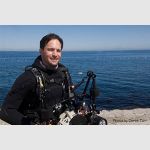
Anita Verde photographing an oceanic sunfish in the waters of Baja California, Mexico
If you know Anita Verde and Peter Marshall—or you’re acquainted with them from their work in the pages of DPG and elsewhere—you may know that there are few things they love more than heading to the Baja Peninsula to photograph the joyful mayhem that is the sardine run. (Read their article, “The Best of Mexico: Sea Lions, Cenotes and the Sardine Run,” to find out why Mexico is such a great place for wide-angle photography.)
But the 2025 season didn’t just serve up the expected marlin, dolphins, mahi mahi, California sea lions, and variety of dive-bombing marine birds; the Australian husband-and-wife team also came across something very special—and very different—indeed. The encounter resulted in “Wandering Ocean Moon,” Anita’s unique shot of an ocean sunfish and a freediver that would later grace the cover of Alert Diver magazine and also earn a “Highly Commended” recognition in Ocean Photographer of the Year 2026. Here, Anita answers our questions about this once-in-a-lifetime photographic opportunity.
DPG: Where were you when you took this image, and what were you hoping to photograph that day?
It was the 2025 season of the Mexican sardine run in Baja California. We were of course there for the sardine run to capture the chaos of predators like striped marlin, sea lions, and whales decimating baitfish—we were not looking for sunfish at all. So the fact we came across one was a complete surprise. Despite having spent a lot of time diving and photographing marine life, this is actually the only sunfish I have ever photographed. So to encounter it in the final hour of our sardine run trip was an extraordinary bonus.
DPG: Tell us about the moment you first saw the sunfish. What was your immediate reaction?
The first thing I noticed when I slipped into the water was how huge and unusually pale it was—almost albino. As it came towards us through the blue, it looked luminous. My immediate thought was that it looked like a giant moon rising underwater. Sunfish are already such extraordinary looking animals, but this individual had a surreal quality to it. I knew straight away that I wanted to photograph it in a way that captured that feeling.

A sea lion takes a break from hunting sardines to investigate a curious visitor
DPG: What made this particular encounter so memorable?
The fact that it was completely unexpected was a big part of it. We had gone to Mexico for the sardine run, where you’re surrounded by an entirely different kind of energy—frantic baitfish, predators, birds, marlin, and constantly changing action. Seeing the sunfish was such a contrast to everything else that we had experienced during our week. The glassed out conditions and beautiful light made the encounter feel so calm. It was like the ocean had decided to gift us a completely different feeling for our last hour.
DPG: Sunfish are such unusual-looking animals. Did that influence how you approached the photograph?
Very much so. I think part of their appeal is that they don’t fit our conventional idea of what a beautiful fish looks like. They’re enormous, odd, and slightly ridiculous, with that huge body and truncated shape, while there is something also incredibly graceful as they move through the water. I wanted the photograph to embrace that oddity rather than try to make the animal look conventionally beautiful.

The Mola mola: a strange—and strangely fascinating—ocean wanderer
DPG: How did the conditions help create the image?
We were incredibly fortunate with the conditions. The water was clear and blue, and the light was clean and even, which gave the sunfish an ethereal glow—like a halo around its huge white body. The conditions really did the work. The ocean had set the perfect scene, so there was no need to overcomplicate it.
DPG: How did you approach photographing such a large animal with a freediver in the frame?
I was shooting with my Nikon Z8 and a 24–70mm lens in SEACAM housing. The focal length gave me enough flexibility to respond to the animal as it moved without getting too close to disturb it. The encounter unfolded naturally in open water and was not staged, so finding a relationship between the two subjects that felt natural was easy. I didn’t want the freediver to become a tiny afterthought, but I also didn’t want them to dominate the scene.
I just positioned myself and waited for the right moment. I deliberately chose the frame that shows the moment the freediver and the sunfish appear startled by each other—which you can see in the sunfish’s facial expression.

Weird on weird: Sunfish with salp
DPG: Was there a moment when you knew you had captured something special?
There was a point where the sunfish and freediver came together beautifully within the frame and the light was just right, so I got the feeling that the photograph had worked before I reviewed it on the back of my camera.
But I didn’t really think much about the image until the following day when I looked at the frames I had taken on my laptop. And, it was only after posting it to my Instagram story, when Stephen Frink from Alert Diver contacted me about it, that I realized it was maybe something a bit special. Seeing it on the front cover of this year’s Quarter 3 issue of Alert Diver magazine was a real treat.
DPG: You were sharing the encounter with your husband and good friends. Did that make it more special?
Absolutely. Some photographs are all about the image, while others are tied very strongly to the experience of making them. My husband Peter and I keep returning to Baja with the same group of good friends. And it’s the energy of being there, photographing with them that makes the trip so special.

A bucket-list encounter made even sweeter when experienced with special people
DPG: What do you think the freediver adds to the photograph?
The freediver gives the viewer a way into the image. I was able to capture many beautiful portraits of this sunfish during the course of our interaction where you can appreciate its strange beauty, but without the freediver in the frame, it is much harder to understand the experience of being in the water with such a magical, alien-looking animal. It also gives you a feel for the size of this impressive fish.
DPG: How important was patience in creating the photograph?
With wildlife photography, you don’t get to direct the subject. You can position yourself, anticipate movement and make decisions about composition, but ultimately the animal decides what happens. Often you also have others in the water with you, you need to check the sun angle, and you only have moments to get the shot. The trick is to be ready to capture the right moment. In this case, I wasn’t trying to force a particular image; I was watching the animal and waiting for the right opportunity to bring it all together.
DPG: When you look at the image now, what do you remember most?
I remember that first impression of the animal emerging from the blue. It really did look like a giant moon. But I also remember looking around and seeing my friends experiencing the same thing. I came to the realization that we were experiencing something very rare and special that we should savor. The photograph is wonderful to have, but the memory of actually being there is what makes it special to me.

“Wandering Ocean Moon”: The image that made the cover of Alert Diver magazine and was “Highly Commended” in Ocean Photographer of the Year 2026
DPG: As this is the only sunfish you’ve ever photographed, does that make the image more significant to you?
Definitely, as it has now become my personal reference point for the species. And I couldn’t have asked for a better introduction. It was one of those completely unexpected encounters that you couldn’t plan even if you tried.
DPG: If you could go back and photograph the encounter again, would you do anything differently?
I’m sure I could find something to change technically—photographers are very good at finding faults in their own photographs, but honestly, I wouldn’t really change anything. You can spend a lifetime chasing the perfect conditions, the perfect subject, and the perfect composition. Every now and then, the ocean simply gives you something you weren’t expecting and it all comes together. This was one of those moments.
DPG: Finally, what does this image mean to you personally?
It captures exactly why I love wildlife photography. For me, it is not about going into the ocean with a particular shot in mind. I rarely do that. It’s about being open to whatever happens. I love the spontaneity of wildlife photography. The fact it is totally unexpected is what makes it wild; and that makes it even more special when it happens. Perhaps that’s what I love most about the ocean.

Anita and trusty SEACAM wide-angle rig
Anita Verde is one half of Summits to Seas, the other being her husband Peter Marshall. The duo share their travel experiences, both above and below the waterline, through images and stories in both print and online publications around the world. Anita and Peter are longtime DPG Field Editors. See more of their work on Instagram.
RELATED ARTICLES


Featured Photographer